Description
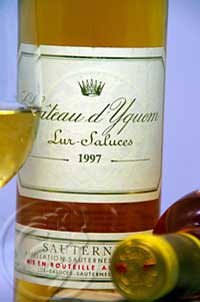
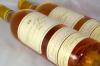
Yquem's 1991 is a beautifully made, medium gold-colored wine with a gorgeous nose of creme brulee, roasted coffee, and sweet, honeyed pineapple and other assorted fruits. Full-bodied, unctuously-textured, and rich, but not yet revealing a lot of complexity or enormous weight.
History
Sauternes is 25 miles south east of the city of Bordeaux and is in Graves. It produces the famous sweet dessert wines such as Chateau d'Yquem. These wines are not cloyingly sweet like Sherry but have a wonderful flavours of apricots, passion fruit, tangerine, vanilla, peaches, dried pineapple, nuts and honey. They are beautiful wines and the finish lasts on the palate for a long, long time. These dessert wines have an incredible ability to age and continue to develop for decades. Their colour is gold which darkens with time to a deep copper and they have a a refreshing acidity which makes them sought after all over the world.
Sauternes is an unusual place in that it lies in the hollow where the River Garonne and its tributary the Ciron converge. The source of the Ciron is a spring which has cooler waters than the Garonne. In the autumn, when the climate is warm and dry, the different temperatures from the two rivers meet to produce mist that descends upon the vineyards from dusk till dawn. The mist helps the development of the botrytis cinerea fungus (known as Noble Rot). Noble Rot makes the the grape concentrate the flavours and sugars whilst keeping a high level of acidity. By mid day, the warm sun will help dissipate the mist and dry the grapes to keep them from developing less favourable rot. Sauternes has 5 communes - Barsac, Sauternes, Bommes, Fargues and Preignac. All 5 can use the name Sauternes but Barsac also has its own appellation. Wines from Barsac are lighter and have a fresher style.
Being from the Graves region the terroir of Sauternes is gravel, clay and limestone but Barsac ( which is in the north west of Sauternes) has a red, sandy alluvial limestone base and its wines have a different character. The grapes grown in Sauternes are those which make White Bordeaux - Semillon, Sauvignon Blanc and Muscadelle. Unlike White Bordeaux Semillon, makes up most of the blend as it is easily infected with Noble Rot. Sauvignon Blanc provides acidity to counter balance the sweetness and Muscadelle contributes fragrance. Sauternes is expensive due to the labour intensive methods of its production. Grapes have to be hand picked so that only those with Noble Rot are selected and yields can be low. It is said that one grape vine only makes enough juice to make one glass of wine!
Chateau d'Yquem is the only wine with the classification of Great First Growth (Premier Cru Superieur). Yquem is described as the greatest dessert wine in the world and is located on the highest hill in Sauternes. While the wines can be drunk and enjoyed when young, they continue to develop, adding layers of complexity, in the bottle and can be kept for up to 100 years.
The Chateau once belonged to Eleanor, Duchess of Aquitaine and was brought under the English crown by her marriage to Henry Plantagenet, who became King Henry II of England in 1154.
Chateau d'Yquem returned to France at the end of the Hundred Years War in 1453. The Sauvage d'Yquem family owned the Chateau from 1593 until the 18th Century. In 1785 Francoise-Josephine Sauvage d'Yquem married the godson of Louis XV, Comte Louis Amedee de Lur-Saluces of Chateau de Fargues. He died just 3 years later after a horse riding accident and the young widow focused on improving the Chateau and its vineyards. Chateau d'Yquem has not altered in size since she established it in 1788. She was known as "The Lady Of Yquem" and was responsible for the construction of a new wine cellar in 1826.
The Lur Saluces family continued to improve the quality and prestige of Yquem down the centuries despite the Chateau being used as a Military Hospital during the First World War. Bertrand de Lur-Saluces steered Chateau d'Yquem through these difficult times with great skill. He is an important figure in the history of Bordeaux - he was a co-founder of the Bordeaux Academie du Vin, the Conseil Interprofessionel du Vin de Bordeaux, and was president of the Union des Syndicats de Sauternes. Today the Chateau is owned by LVMH (Louis Vitton - Moet - Hennesy) with Pierre Lurton of Chateau Cheval Blanc running the estate.
The vineyards of Chateau d'Yquem stretch over 457 acres between the villages of Sauternes and Fargues and there are a tapestry of soil profiles, predominantly gravel mixed with sand topsoil upon a water retentative clay sub-soil. The harvest at Chateau d'Yquem can last for weeks and involves several passes by up to 150 harvesters. The harvesters pick individual berries rather than the normal process of harvesting entire bunches. It's an amazing wine and if you ever get the chance to try some - do! It's well worth it.
Food Recommendation
Foie Gras
Cheese Recommendation
Blue Cheese
|